Showing posts with label japanese culture. Show all posts

Sunday, May 06, 2007

Ryoanji –  竜安寺 or Rocking Enlightenment

Japanese shrines are famous for being ancient, tranquil and philosophical. Most likely, you are well aware of the concept of the rock garden. In concept, the Rock Garden is very simple – some monks place a bunch of rocks in a garden and contemplate them. Of course, there are 1001 cliches that one can use to justify the trip up to see one. In short – they are peaceful. This is something that you can gather from any stereotype, wikipedia entry and guidebook. What you can’t grasp without checking one out is the fact that the clichés are right. It *is* peaceful, and it does make you want to contemplate your place in the world.

Photo Sharing and Video Hosting at Photobucket

And by "contemplate your place in the world", I definitely mean "strike stupid poses in front of thousand year old scenery"

One of the places that we visited in Kyoto is called “Ryoanji”. It's famous. And popular.


Amazingly, despite the crowd, it's somehow actually easy to find peaceful spots throughout the shrine.


Most famous, and probably most peaceful is the famous rock garden that Ryoanji boasts. Rock gardens are sculpted out of .... well... rocks. But they are sculpted to represent waves, water and the motion that goes with them. Somewhere in the representation of chaos and movement in a static field of rock is a scene that actually makes you want to sit and think. I actually did sit and think for about twenty minutes. The garden was calming, relaxing and rather amazing. Although a good ten minutes of my twenty minute think was focused on the potential enlightenment potential of the word "cannonball", I did manage to restrain myself from following that spiritual path.

But man, it would have been ugly if I was better at zen.

In any case, this garden is actually a well known signpost on the path to enlightenment. Legend has it that anyone who can see the 14 stones in this garden at the same time has truly reached enlightenment.

Let's try to get 14.


Three...or maybe four, depending on how you count that cracked one.


Seven rocks and seven tourists that are still looking at PICTURES OF THE ROCK GARDEN! GAH! IT'S RIGHT IN FRONT OF YOU! (pant pant pant....sort of fourteen....)


Seven.


Two! Gar. Getting farther from zen peace with each picture.


Six! This is about as well as I'll do.


A 90 degree rotation yields.... three.


One ... and a cross? Interesting.

In any case, I did find enlightenment there. Maybe it’s because the “bu” in “burento” or “無連斗” also happens to translate as “zen”, but I figured it out.

All you need to do is look at the Rock Garden from the TOP.

Photo Sharing and Video Hosting at Photobucket

Ha! Instant enlightenment. Leave your 100 yen coin in the box at the door and don't forget to tip your waiter, ladies and gentlemen. The above is a picture of a scale model of the garden. I wouldn't want to post instant enlightenment here on my blog. I'd rather you read at least a few articles and find enlightenment. If you *really* want to understand enlightenment, you should start with the penis festival.


Now that we're somewhat enlightened, anyway, we can move on to the second amazing thing about Ryoanji.


This fountain is actually contains a symbol that consists of four different kanji, all of which use the centre box as part of their shape.


吾 唯 足 知

These can be translated in several ways.

According to Google, they mean “Our (something) foot knowledge”.

This is very deep, but my friend Dave had a better translation:

“Learn only to be contented”.

Or, in other words, you should educate yourself, but your goal should be contentment. Don't worry as much about competing with others or achieving certain targets. You should study things that make you content.

Pretty cool. In fact, the next time you are bummed out because you failed a test, you can bust out some zen philosophy to rationalize away those “C” marks to your heart’s content!

In an even more brilliant melding of zen philosophy and Japanese ingenuity, this very same symbol is available at the gift shop. You can get it as a key chain, paper weight, or best of all, with the centre hole re-purposed as a beer bottle opener.

Now that’s spiritual enlightenment I can work with!

Wednesday, April 11, 2007

Japanese Thank You - どもありがとう (ございます)

Sometimes, I am reminded that Japanese is often more formal than English. To properly express a given meaning in a given situation, sometimes you need a lot more talking.

Bill Murray's character demonstrates some of what might get lost in translation during an aptly named movie (er, "Lost in Translation", for those of you asleep in your sashimi). During this scene, Bill Murray's actor character (Bob) is trying to shoot a commercial with a Japanese Director.

Here's the scene, translated fully into English. (Thanks Wikipedia!)

Bob: Does he want me to, to turn from the right or turn from the left?

Interpreter (in formal Japanese, to the director): He has prepared and is ready. And he wants to know, when the camera rolls, would you prefer that he turn to the left, or would you prefer that he turn to the right? And that is the kind of thing he would like to know, if you don't mind.

Director (very brusquely, in colloquial Japanese): Either way is fine. That kind of thing doesn't matter. We don't have time, Bob-san, O.K.? You need to hurry. Raise the tension. Look at the camera. Slowly, with passion. It's passion that we want. Do you understand?

Interpreter (In English, to Bob): Right side. And, uh, with intensity.


I'm pretty sure this is spot on.

Photo Sharing and Video Hosting at Photobucket


/of course, they might just be giving additional instructions here, like "On alternating Juesdays, this walkway is flooded with molten lava. Please use the other exit."

Friday, April 06, 2007

Kinkakuji: historical....bling?

Well known fact #1: Kyoto has a fair number of temples.

The Truth Behind it: Yep, this one is true. There are about 321089293 temples in this town, or at least it seems that way. There is no way that one can visit any significant portion of the cultural treasures that this city holds. Of course, one can certainly visit a good number of the famous ones, and therefore have enough experience to make snap judgements on the entire city.

So, without further ado, I’m proud to present FAMOUS TEMPLE SNAP JUDGEMENT # 1: Kinkakuji.


Kinkaku-ji is actually part of a large Buddhist temple complex, known as Rokuon-ji.

Photo Sharing and Video Hosting at Photobucket

It's easy to find, as there is very massive kanji on the hill nearby.

Photo Sharing and Video Hosting at Photobucket
This large character means ... "large". Very straightforward.

Before we get into the temple and what makes it so fancy, perhaps a quick TSI refresher in Buddhism is in order. Buddhists teach that life is suffering, and that one should turn inward to seek spiritual enlightenment, rejecting immoral behavior and following a sacred path. Buddhists believe that following the path helps them resist the source of suffering, which is desire – including lust, greed, envy and all that other fun stuff. As with most major religions, the the sacred path includes some of the usual “no-nos”: No Killing, No Lying, No Copious Humping Of Russian Prostitutes. Some Buddhists have other unique rules: No Sleeping On Giant Comfy Beds, and the Gremlin-esque*, No Eating After Noon.

Ok! Now that we are all up to Buddhic speed, we can get back to the TSI investigation.

You see, Kinkakuji is interesting, given its current status as a Buddhist temple. Once upon a time, back in 1397, the Shogun decided to visit the area. Someone decided that perhaps they wanted to help the Shogun see that the riches of the material world are only skin deep, or maybe they wanted to distract him from all of the sorrow in the world, or maybe they just wanted him to make their local temple a major part of his Shogun-circuit, but they decided to outfit one of the pavilions in a very unique manner.

Pure Gold.

Photo Sharing and Video Hosting at Photobucket


Kinkakuji or “金閣寺” translates as “Temple of the Golden Pavillion” – which is pretty much spot on, as you can see.

Photo Sharing and Video Hosting at Photobucket

It's really pretty.

Photo Sharing and Video Hosting at Photobucket

Some years later, someone thought that a building covered in gold jived really well with the Buddhist persuit for personal fulfillment. I totally see the connection, don't you?

Buddhist A: Forget the desires of the ouside world!
Buddhist B: Woah! Check out that gold building! It's purty!
Buddhist A: WOW! THAT'S AMAZING!!!!
Buddhist B: What were we doing again?

I’m sure I'm not alone in seeing the wonderful irony that exists when a group focused on ignoring the desires of the outside world has an entire building that was blinged* up to impress a visiting dignitary. That’s serious comedy.

Of course, Buddhists are hardly the only religion that seems to have done something counter-intuitive to the basic precepts. Buddhists have made a vast contribution to enriching the art and culture of the entire world. Don’t let the TSI team take anything away from their work. After all….I don’t really want to get into listing examples of major world religions whose followers’ actions don’t jive with their teachings.

Mind you, MerryManMakingIllInformedAndIllResearchedSocioCulturalReligiousStereotypicalJudgments doesn’t have the same ring as the current title, does it? So I'll keep the jokes-at-the-expense-of-monks to a minimum.

Mostly.

Anyway, where were we?

Ah, yes. Ancient Temple. Covered in Gold. Right. GOLD.

Photo Sharing and Video Hosting at Photobucket

Er… did I say ancient? Well… about that…

If you happen to run over to the official website run by the tech-savvy monks that run the temple that runs this temple. (got that?), you might notice that there is an interesting gap in the history of the temple. They stop at about 1917.

Why might that be?

Well, this is hardly something that the temple folk like to publicize, as it might not be the best sales pitch for attracting potential visitors. You see, their definition of “ancient” is a bit flexible.

Let’s set the way-back machine to... oh... 1950.

Back then, there was a crazed monk. Now, we can surmise that this crazed monk didn't appear to be crazed at the time. In fact, he was likely quite popular among the local monk-dom (and the monkettes? Platonically, of course, as monks are celibate I think.... unless they are allowed to date within carefully proscribed monk-ey boundaries? Ah, I digress....) Monks tend to have a fair bit of time on their hands. Each monk is expected to dedicate themselves to some pursuit or other. This monk happened to choose the Temple of the Golden Pavilion as his dedication-thingey. And dedicate he did. In fact, he built up a healthy obsession to the point where he felt that the temple was controlling his life.

We all have various methods of dealing with stress. I personally feel that “reading a book”, “buying a model train set” or even “getting copiously drunk on cheap convenience store sake and calling random people in your cell phone” are good ways of dealing with stress - at least compared to what this fellow chose to do. (A healthy Facebook and/or MySpace addiction is also a semi-reasonable way to spend time, but sadly our anti-hero had the misfortune of being born long before our wired, enlightened times)

Anyway, our chap decided to do something a little more elemental to cope with his fixation on the temple.

He burned the five and a half century old struture to the ground.

Ta DA! Problem solved!

You see, this beautiful, ancient golden temple/tourist trap is actually a recent reconstruction. Although his fact made for several straight-to-video movies and a few comic books, it is not exactly published anywhere in the temple literature. Sneaky, sneaky monks.

Why might the monks keep such a major event in temple history (ie, the end of it) on the down-low? Well…. It comes down to economics. Temples are actually pretty sound business centres, which own fair amounts of property and are not ashamed to make a bit of coin here and there. You might even spot the odd BMW here and there, and some temples actually run large, fancy hotels (tune in soon for TSI: Temple Hotel).

Photo Sharing and Video Hosting at Photobucket

A major source of income for the monks is the asmission fees they charge tourists to come in and look around the temple grounds. This isn’t a huge amount of cash - anywhere from 300 yen to about 1000 yen per person - but it adds up. In fact, a nice temple on a busy train line can make some serious coin.

And when I say "serious coin", I mean that they are serious about collecting your coin.

Photo Sharing and Video Hosting at Photobucket

Can you really blame them? They have a temple that’s covered in freakin’ GOLD, and you can can bet that it brings in a huge amount of tourist money. Temples are expensive to maintain, so there's no problem with charging people admission to enjoy them. But.... what happens when your world-famous temple goes up in smoke? (sorry. had to be said). Well..no more tourist money.

But what to do? What to do?
Of course, rebuilt it!

Heck, why not improve things a bit?
Sure! During the reconstruction, they even extended the gold leaf over the entire building – an improvement, so to speak.

Problem solved. The hordes of tourists still show up in droves. The monks, of course, are sure to provide for your every tourist need.

You want fortunes? And you don't speak Japanese!

Photo Sharing and Video Hosting at Photobucket

No problem!

Photo Sharing and Video Hosting at Photobucket

Just be sure to have your hard money ready!

Photo Sharing and Video Hosting at Photobucket

The fact that they forgot the word "earned" should NOT be taken as any sort of underhanded criticism of the monk-ey lifestyle. They pay down like everyone else.


Anyway, the whole "reconstrucing the burned temple" thing has, of course, spread a few seeds of doubt. In order to reassure people that the temple is not being reconstructed regularly with other gold-like materials, they have placed it under 24 hour internet surveillance.

If you want to check it out, try this webcam:


Since Japan is in a different time zone, you can catch some fairly beautiful views during times when the temple is not normally open to the public. I checked it at around 5:00 EST, and got a pretty amazing sunrise. So have a peek, and remember: The “Click here to have a deranged monk burn down the Temple” button has been disabled in both IE and Firefox.


Welcome back. Sure is pretty, isn’t it?

In a way, it’s somewhat of a metaphor for Japanese society. The reconstruction hasn’t really made a difference to most of the tourists coming. It’s still a stunning structure, and one of the most beautiful places I have ever been. I highly recommend the trip if you happen to be in the neighbourhood. Fittingly, the top of the roof has a phoenix mounted on it.

Photo Sharing and Video Hosting at Photobucket

Out of the flames, the Temple of the Golden Pavilion rose from ashes, to once more become a beautiful, fascinating place.

Japan is much the same. It has risen from challenges and destruction over much of its history. The way things appear to be is of vital importance. Harmony is to be preserved at all times, and if things appear to be working, they are working.

Japan loves beauty in all things – people, relationships and places. This exterior judgement plays out in a hundred thousand ways each day – from Louis Vutton bag toting gals whose full time job is fashion to late-working, nine-coffee-break-taking salary men, appearances are to be maintained at all times.

Somehow, for a building like this, it doesn’t really matter. The building might be fifty years old – a cultural Disneyland, carefully manicured to a perfect theme park experience designed to bring in tourist dollars – but it does it really matter? Kinkaku-ji is breathtaking, photogenic and immeasurably memorable.

Photo Sharing and Video Hosting at Photobucket

After all, if someone had the audacity to gold-plate a Motel 6, that would still be worth the trip. This place at least has the courtesy to look like it deserves the attention.

Photo Sharing and Video Hosting at Photobucket

The Monks have the right idea. Forget all about that little glitch in the perfect history of this perfect cultural treasure. Take it in, take pictures and let yourself sink into the majesty of what is surely a crown jewel in a town full of treasures.

  
Photo Sharing and Video Hosting at Photobucket


* Gremlinesque. “The Gremlins” was a famous movie about cute, cuddly creatures that turned into horrible monsters if you fed them after midnight. I suspect this is not true for most Buddhists.

* blings – to bling. Usually a noun, “bling” is a word from American hip-hop, which describes lots of expensive shiny things, like gold and diamonds.

* Japan is 13 hours ahead of EST right now, and 14 during daylight savings time.
Sunday, July 30, 2006

Wa: Do not disturb

Sometimes, when I see a particularly wonderful sign, I make out with it.

For example, here is a sign that discourages litter in a truly Japanese manner.

Photobucket - Video and Image Hosting
I like to make out with signs that use this much subtlety. It shows my subtle appreciation of their subtle subtlety.

This sign is a great example of the Japanese phenomenon of "wa." Wa means "harmony" (EDIT: The character for "WA" is "和". BIG thanks to Mr. or Ms. "Ouch!" for that!). Simply, keeping the "harmony" means that people go to great lengths not to rock the boat or cause any conflict that would disturb this "wa".

The "Wa" is not only a big part of Japanese signage, it is also a huge part of Japanese working culture. In practice, keeping this "harmony" means that when I have a problem with someone (eg, "Bob wears too much pink, and I can't work because he is too sexy")), I should definitely NOT tell Bob that I have this problem. Rather, I should go to Bob's superior officer, who will in turn go to their superior officer, who will then go to THEIR superior officer, who will then move up the chain of command until we contact God and/or the offending person's parents. That entity (ie. God and/or the person's parents) will then go back down through a different chain of command, until we manage to reach a DIFFERENT superior officer, who will contact the person with whom I have a problem. The officer will then inform the offending person of the problem in a round-about, non-specific manner (eg, "Bob, your shirt is very nice, but it is a bit too pink. *Some people* are having a problem with the amount of sexiness that you are bringing to the workplace.... can you please wear somewhat less pink?) This, of course, avoids any direct co-worker to co-worker complaints, and helps everyone theoretically work together because no one ever has a specific problem with anyone, and everyone will tell everyone else that they love their work. Random complaints from *Some people* will just appear every now and again.

This is all well and good, but it takes fucking forever to pass the complaint along. The problem may be a month or more old before anyone says shit. The problem may also be a very simple one to resolve (eg, "please speak more slowly"), which could be solved within a few seconds of hearing said complaint.

Here is a relatively short example with a very short "wa - train", as I have decided to call the chain of people who must ALL find out about the issue before you do. My school manager is a relatively astute young lady who is quite delightful. She realizes that western people tend to appreciate slightly more direct feedback:


Mg: "Brent Sensei, how do I say in English.... "Sensei, can you not get dressed out of your suit before the end of day???"

Me: "um..... That was pretty good."

Mg: "Really?"

Me: "Yes."

Mg: "Ok... um... can you tell (the other) Sensei?"


So, as you can see, my school manager has realized that we crazy foreigners appreciate direct feedback. Admittedly, she sometimes tries to give said direct feedback, but it often comes out slightly more blunt than the spirit in which it is intended. For example, this gem which my dear new co-worker received the other day...


"Sensei... lesson was a good job. But next time... please try to...um...more...uh...make more fun."


Ouch.

Serious wa disturbance.

Saturday, November 26, 2005

Mostly dead. Entirely Delicious.

I would like to say that I am not a squeamish man in terms of what I eat. I figure that since my ancestors bitch slapped their way to the top of the food chain, the least that I can do to show them that I appreciate all the hard work. In my opinion, the best way to show this appreciation is to not shy away from eating things that said ancestors bitch slapped on their way to the eventual signing of the Kyoto Accord, formation of the WWF, etc. In short, I try to stick anything put in front of me into my maw.

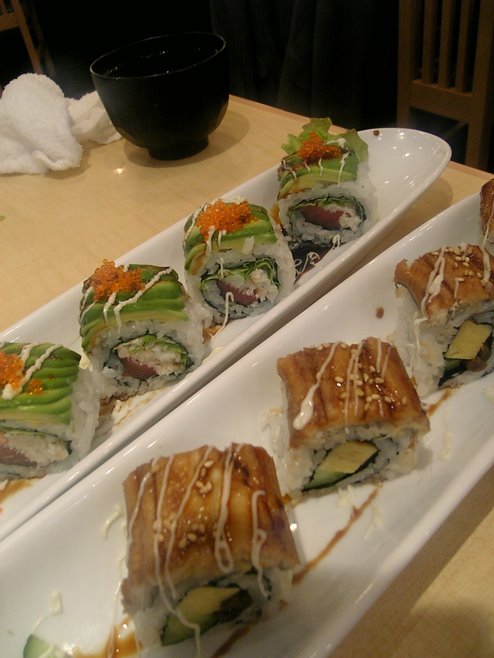
With that disclaimer for the following tale out of the way, I can safely say that I love sushi very much. VERY much. And not just those sissy rolls that involve things like “cooking” in the preparation process. Thus, you can imagine that I live in Japan with quite a lot of excitement about the entire eating party. Occasionally, I even get some strange surprises. Like finding a place that offers uber fresh sushi near my apartment as the team was on the way home from Yomuriland-mae.

This sushi restaurant also had an amazing extra little thing on the menu that made the sushi even better…. a little special called “All you can drink for two hours” for UNDER ONE THOUSAND YEN. That’s 980 Yen… or about $9.80CDN at the current exchange rate. Draft or bottles, hard liquor, wine, you name it. Two hours to guzzle as much as you can. OK, raise your hands if you think that this would be the best thing ever…

Yeah. Me too.

To top it all off, they happened to serve a few things that would make a certain ex girlfriend of mine want to call the wraith of the heavens down on my head (…cough….uh…er…again…).

That’s right! This joyful place served both RAW WHALE and RAW HORSE!

The whale is held in my eager chopsticks, and the horse in Nick’s. Yep, they happen to taste pretty awesome, actually. Well, whales wouldn’t be so freaking endangered if they didn’t taste so good. Sheesh. And as for Mr. Ed, well, I now know that you can not only ride him to lunch, but eat him for it too! No cooking required. It was tasty-good!

Image hosted by Photobucket.com

Shocked? Offended? Hungry? Hopefully all three, because I hate to say it, but the real shocker actually came in the NEXT course.

Fish that was so fresh it was only barely dead. I mean BARELY DEAD. They pull it from a tank, slice off the sides, skewer it and serve it. Probably in not much more time than it took you to read this paragraph. This means that your fish is rather fresh.

Image hosted by Photobucket.com

So fresh, in fact, that it is still twitching on the table for the duration of your entire meal. A good twenty minutes of occasional jitters and fish flips. Seriously. The mouth opens and the fins jitter, the gills flip every few minutes….. all while you much away.

I wanted to show this poor fish just how much I appreciated his good work on the table, so I made a point of holding bits of said dinner up in front of said fish’s eyes before I ate, which understandably guarantees me the same fate if/when I am abducted by little green men with a taste for Burentomeat. But seriously, it was good, and I wanted the fish to know. It was So. Freaking. Good. Perhaps the best sushi I’ve ever had, and we snagged this little offense to western sensibilities for about 500 yen. I also snagged a few videos, so if you are interested, email me and you can watch us guzzle fish meat in fuzzy camera-phone-vision and drunk-stereo sound.

After we were suitably shitfaced and full of fish for under twenty bucks, we hit up the local karaoke bar, belted out our lungs and made it home incident free!

...


To prove how sober and incident free the night was, here is a picture of me being felated by Santa Claus.

Image hosted by Photobucket.com

Thank you and good night.